Continuous Field Monitoring of Growth and Thickness Variation in a Potato Tuber Using a Strain-Gauge Sensor
Overview
Monitoring crop growth and water status is essential for understanding plant development, improving agricultural management, and making informed irrigation and harvest decisions. Although sensors can continuously measure changes in the diameter of aboveground plant stems and fruits, monitoring the growth of underground crops presents additional challenges because surrounding soil can interfere with mechanical measurements.
In Continuous Field Monitoring of Growth and Thickness Variation in a Potato Tuber Using a Strain-Gauge Sensor, Steven O. Link investigates whether a strain-gauge sensor can measure the growth and daily thickness fluctuations of a potato tuber directly in an agricultural field.
The study explores a method for monitoring belowground crop development at short time intervals, offering a way to investigate changes that conventional periodic measurements may not capture.
Research Objectives
The study had three primary objectives:
- Determine whether a strain-gauge sensor can monitor the growth of an underground potato tuber under field conditions.
- Separate longer-term growth from daily thickness fluctuations to investigate changes associated with tuber water status and estimate daily water loss.
- Examine the relationship between estimated daily water loss and vapor pressure deficit, a measure related to the atmosphere’s capacity to draw moisture from plants.
Together, these objectives address the potential for continuous belowground measurements to improve understanding of crop growth and water dynamics.
Methodology: Continuous Potato Growth Monitoring
The field study was conducted in an irrigated potato field near Pasco, Washington, using a Shepody potato cultivar. Data collection took place from July 9 to July 22, 2025, until harvest.
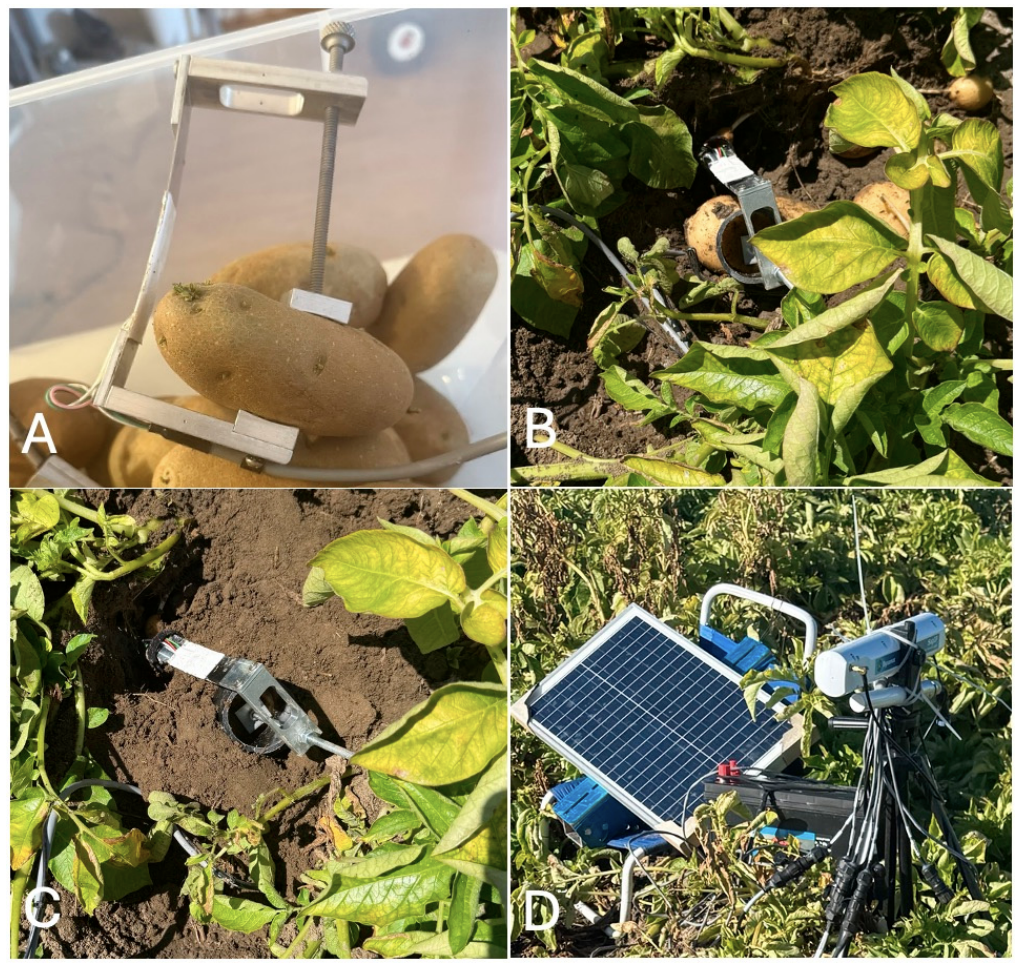
A strain-gauge sensor was attached to an individual potato tuber to measure small changes in its thickness. The sensor was connected to a wireless data logger, which recorded measurements every 15 minutes. Temperature and soil moisture sensors were also used to help interpret the measurements and identify possible sources of interference.
Because strain-gauge sensors can be affected by temperature, the researchers applied a temperature correction to the measurements. They also identified and removed outliers associated with irrigation-related interference and other sources of noise.
To distinguish long-term growth from daily thickness changes, the researchers fitted a growth trend to the recorded measurements and examined the remaining variations. These fluctuations were then used to estimate daily water loss from the tuber and investigate its relationship with estimated vapor pressure deficit.
The mass-growth estimates were derived from the measured tuber thickness using a mathematical relationship between tuber dimensions and mass, rather than from repeated direct weighing throughout the experiment.
Key Findings
1. Continuous Measurement of Belowground Growth
During the 11 days used for the daily growth analysis, the monitored potato tuber increased in thickness by 0.80 mm.
Using the final measured tuber mass and a dimensional relationship, the study estimated a mass increase of approximately 1.4 g per day, equivalent to a 4.2% increase over the observation period.
These results demonstrate that the sensor recorded a consistent growth trend while the tuber remained in the field.
2. Daily Thickness Variation and Water Status
In addition to longer-term growth, the sensor recorded recurring daily changes in tuber thickness. After temperature correction and separation of the growth trend, the daily thickness variation ranged from 0.216 mm to 0.439 mm.
The largest observed daily variation corresponded to an estimated water loss of approximately 9.1 mL, or 2.9% of the tuber’s estimated water content. The minimum estimated daily loss was 4.7 mL, or 1.5%.
These results suggest that continuous thickness measurements may provide information about daily water-status changes in underground storage organs.
3. Relationship Between Water Loss and Atmospheric Conditions
The study found a positive relationship between estimated daily tuber water loss and estimated vapor pressure deficit. The reported relationship was statistically significant, with an R² value of 0.72.
This finding is consistent with the possibility that atmospheric conditions influence water movement within the plant and its tuber. However, the relationship was exploratory because the vapor pressure deficit was estimated using weather observations from a location approximately 8.8 km from the field.
4. Importance of Temperature Correction and Signal Processing
The research also demonstrated the importance of accounting for sensor temperature effects and removing anomalous readings.
The sensor experienced periodic interference associated with irrigation and other possible sources of electrical noise or soil vibration. Temperature correction and outlier filtering helped the researchers distinguish biological changes from measurement artifacts.
These observations highlight the importance of reliable data processing when applying sensitive electronic sensors in agricultural environments.
Download the Full Research Paper
Significance for Precision Agriculture
Underground crops are difficult to monitor continuously because their development takes place beneath the soil surface. Conventional approaches often rely on indirect indicators or measurements taken at intervals.
This study demonstrates a potential alternative: measuring changes in the dimensions of an individual tuber over time.
With further testing and validation, continuous belowground growth monitoring could contribute to several areas of agricultural research and management.
Crop Growth and Yield Estimation
Irrigation and Water Management
Monitoring daily changes associated with tuber water status could help researchers investigate how water availability and atmospheric demand affect underground crop development.
Future work may explore whether these measurements can contribute to irrigation scheduling or more precise control of agricultural inputs.
Harvest Timing and Crop Quality
Research on Belowground Crop Physiology
The ability to observe growth and thickness fluctuations in real time provides an opportunity to study the relationships between belowground growth, water storage, transpiration, and environmental conditions.
The same general approach may also warrant investigation in other belowground plant organs, including rhizomes and thick roots, as proposed by the author.
Study Limitations and Future Research
This study represents a proof of concept based on one monitored potato tuber and one sensor. Its numerical results should therefore not be interpreted as representative of all potato plants, cultivars, fields, or growing conditions.
The estimated mass increase was derived from a relationship between tuber thickness and mass, rather than repeated direct measurements of mass during growth. The estimated water loss and its relationship with vapor pressure deficit also depend on the assumptions and environmental measurements described in the study.
In addition, the researchers encountered measurement interference associated with irrigation and other possible sources of noise. Longer monitoring periods, additional sensors, multiple tubers, different cultivars, and testing across a wider range of field conditions would be needed to evaluate the method’s broader reliability and practical applications.
Further work could also investigate sensor designs for smaller tubers and other underground crops, as well as ways to integrate continuous measurements into crop-management systems.
Conclusion
Continuous Field Monitoring of Growth and Thickness Variation in a Potato Tuber Using a Strain-Gauge Sensor demonstrates the potential of strain-gauge sensing to measure belowground potato growth and daily thickness variation under field conditions.
The study recorded a 0.80 mm increase in tuber thickness over 11 days and identified daily fluctuations associated with estimated water loss. It also reported a positive relationship between estimated water loss and vapor pressure deficit.
Although further validation is needed, the research provides a foundation for investigating continuous belowground crop monitoring and its potential contributions to crop-growth research, yield estimation, water management, and harvest planning.
About the Author
Download the Full Research Paper
Interested in the complete methodology, statistical analysis, figures, and supporting data?
Download the full PDF to explore the complete publication and its detailed findings.