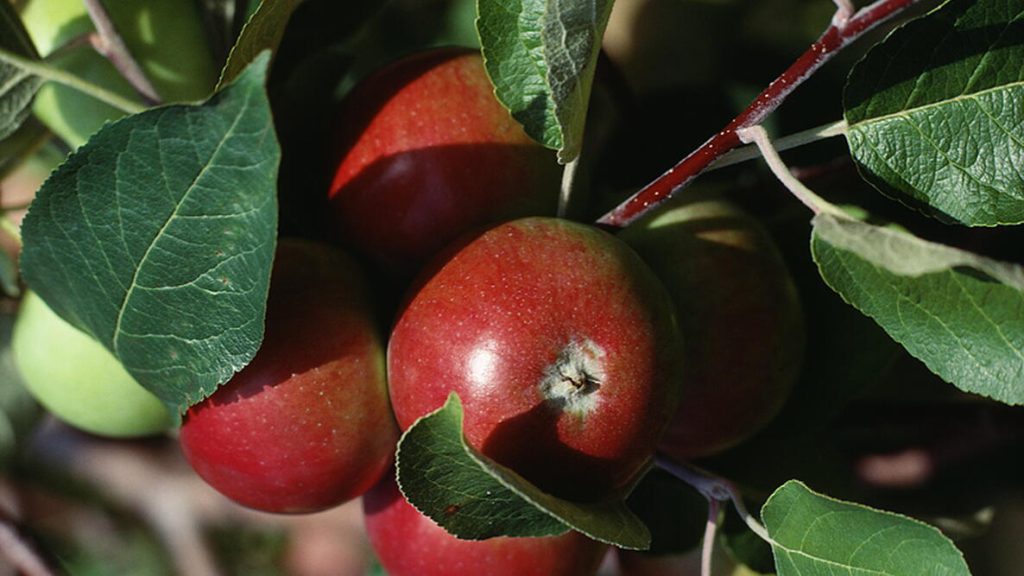
Stand next to an apple tree in September and it looks perfectly still. But if you clip the right sensor onto a piece of fruit and watch it closely, you’ll see it’s anything but static. It’s steadily, quietly getting bigger, day after day, in a pattern that looks nothing like what’s happening in the trunk just a few inches away.
That contrast, between how a trunk behaves and how fruit behaves, was one of the clearest findings when I tested an improved dendrometer sensor in an apple orchard in Mattawa, Washington.
Two Sensors, Two Very Different Stories
We attached this sensor, a small device that clips on and tracks changes in thickness down to a few thousandths of a millimeter, to two tree trunks and to one apple, and let all three record continuously for 15 days.
The trunks did exactly what we expected: a clear daily rhythm, thinner during the day, thicker at night, repeating over and over, adding up to about 0.7 millimeters of change each day. That’s the trunk drawing down its stored water during the heat of the day and topping back up overnight.
The apple told a completely different story. Instead of that strong daily shrink-and-swell cycle, it mostly just grew. Steadily, day after day, with only a mild wobble layered on top, the fruit expanded by a total of 3.3 millimeters over the two weeks we tracked it.
Why Fruit Doesn’t Behave Like a Trunk
The difference comes down to how water and nutrients actually reach a piece of fruit. A trunk is directly plumbed into the tree’s main water transport system, so when the whole tree is short on water during a hot afternoon, the trunk feels that shortage almost immediately and shrinks in response.
Fruit works differently. Most of what fills out an apple during this stage of maturity arrives through a different internal pathway, one carrying sugars and other products of photosynthesis rather than being pulled directly from the same water-stress cycle the trunk experiences. That’s a big part of why the apple kept growing steadily, largely unbothered by the same daily water swings showing up so clearly in the trunk right next to it.
Fruit does lose some water of its own, mostly through its own surface, which is likely why we still saw a very mild daily shrinkage layered on top of its overall growth curve. But that effect was small compared to the steady growth trend underneath it.
Not Every Day Was the Same
The growth wasn’t perfectly uniform. During a stretch when air temperatures climbed to 30 to 33°C, the apple’s growth rate slowed and its daytime shrinkage became more pronounced than on cooler days. That tells us fruit isn’t completely immune to heat and water stress, it just responds more subtly and more slowly than a trunk does, showing up as a dip in growth rate rather than a dramatic daily swing.
Why This Distinction Matters
If you’re trying to understand what’s happening with a crop, trunk data and fruit data are answering two different questions. Trunk measurements are a fast, sensitive readout of the whole plant’s water stress on any given day, useful for fine-tuning irrigation timing. Fruit measurements are a more direct readout of actual crop development, how much size and yield is actually accumulating.
Relying on just one or the other means missing half the picture. A grower watching only trunk data might see a stressed signal and assume fruit growth has stalled too, when in fact the fruit may be continuing to size up steadily regardless. On the other hand, someone watching only fruit growth might miss early water stress building up in the tree overall, stress that could eventually catch up with fruit quality if left unaddressed.
The Takeaway
An apple hanging quietly on a branch is doing far more than it looks like from the outside. It’s accumulating size at a measurable, trackable rate, on its own schedule, largely separate from the daily water rhythm playing out in the trunk beside it. Understanding both signals, together rather than in isolation, gives a much fuller picture of what’s actually happening in an orchard on any given day.
Based on: Link, S.O., Thiede, M.E., van Bavel, M.G. “An Improved Strain-Gauge Device for Continuous Field Measurement of Stem and Fruit Diameter.” Journal of Experimental Botany, Vol. 49, No. 326, pp. 1583-1587, 1998. View the full paper here / Download the paper here