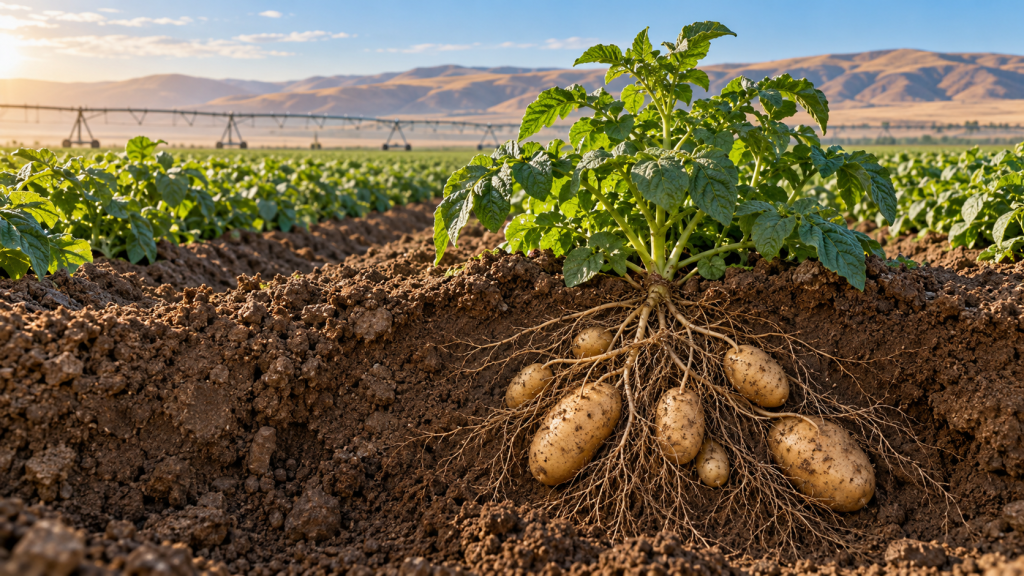
A potato field can look healthy above ground while much of its story remains hidden beneath the soil. How quickly are the potatoes growing? How much does their size change during the day? And what could those changes reveal about water use?
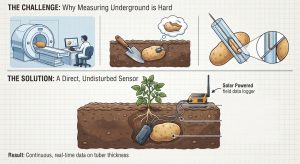
Research described in a presentation abstract by Steven Link, Jacob Blauer, and Michael van Bavel explores a way to answer those questions: sensors that continuously measure small changes in potato thickness while the tubers remain underground.
The abstract, Continuous Field Monitoring of Growth and Thickness Variation in Potato Tubers, reports findings from Washington potato fields in 2025 and 2026. The work offers an early look at how continuous measurements could help researchers better understand belowground crops.
A Closer Look at a Hidden Crop
A potato tuber is the thickened underground part of the plant that growers harvest. Tracking its thickness over time can reveal both gradual growth and smaller daily changes associated with water movement.
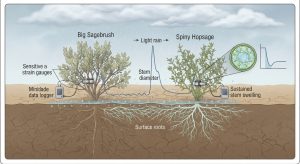
The researchers used strain-gauge sensors, which detect very small changes in size. In the 2026 study, they also tested another type of measuring device called a linear potentiometer.
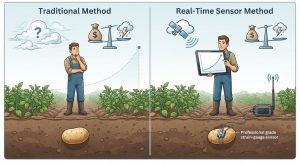
The goal was to follow changes as they happened, rather than relying only on measurements taken at separate points in time.
Download the Full Research Paper (PDF)
What the 2025 Study Found
In 2025, the researchers monitored one Shepody potato tuber in a commercial, pivot-irrigated field in Franklin County, Washington.
During the 11 days before harvest, the tuber increased in thickness by 0.8 millimeters. The researchers estimated that this corresponded to an average gain of 1.4 grams per day.
The sensor also detected smaller changes within the daily cycle. The largest daily fluctuation in thickness was 0.439 millimeters—less than half a millimeter.
From those changes, the researchers estimated a water loss of 9.1 milliliters, or about 2.9% of the tuber’s water content.
Estimated daily water loss increased alongside estimated vapor pressure deficit. This term describes how strongly the air tends to draw moisture from plants. Higher values generally mean greater drying demand.
The finding suggests that changes in tuber thickness may provide useful clues about how the crop responds to conditions above ground.
A Longer View in 2026
The 2026 research took place at the Washington State University Research Potato Farm using Clearwater Russet potatoes.
This time, strain-gauge sensors successfully tracked tubers over 56 days.
The abstract reports that:
- A larger tuber, listed at 210 grams, increased in thickness by 3.3 millimeters.
- A smaller tuber, listed at 95 grams, increased in thickness by 2.45 millimeters.
- Both tubers showed changing growth rates over time.
The linear potentiometers captured expected patterns during some periods, but they had lower resolution than the strain gauges. In other words, they were less able to distinguish very small changes.
Another notable observation came near harvest: both monitored tubers increased in size after the aboveground stalks were cut for curing. The abstract does not establish why this happened, but the finding raises questions for further study.
Download the Full Research Paper (PDF)
Why This Could Matter to Growers
Continuous monitoring could eventually help growers and researchers see when tubers are expanding, how their size changes throughout the day, and how those patterns relate to growing conditions.
The authors identify several potential applications, including more precise management of crop inputs, yield prediction, and harvest decisions.
Those are possibilities to investigate—not benefits already proven by these trials. The abstract reports measurements from a small number of tubers. It does not demonstrate field-wide water savings, higher yields, or a tested irrigation schedule.
The important result is that the sensors captured small changes in underground tubers over extended periods in the field. That creates an opportunity to study crop behavior in greater detail.
Making the Hidden Part of Farming More Visible
These studies show the value of looking beyond what can be seen above the soil.
By following individual tubers through daily changes and weeks of development, researchers can begin building a clearer picture of potato growth and water movement.
For Link Agricultural Technologies, this work connects directly to the goal of using plant measurements to better understand crop needs. Further research can help determine how these measurements translate into practical decisions on the farm.
Download the Full Research Paper (PDF)
About The Research
This article summarizes the oral-presentation abstract Continuous Field Monitoring of Growth and Thickness Variation in Potato Tubers, by Steven Link, Jacob Blauer, and Michael van Bavel. The authors list affiliations with Link Agricultural Technologies LLC, Washington State University, and Dynamax Inc.
This is a plain-language overview of the supplied abstract, not a substitute for a full research report.