Every grower eventually faces the same question near the end of the season: how many more days is it worth leaving the crop in the ground? Leave it too long, and you risk weather, disease, or diminishing returns. Pull it too early, and you leave yield, and money, sitting in the field. For most below-ground crops, that decision has always come down to experience and a bit of guesswork, because there’s been no easy way to actually watch a tuber grow in real time.
That’s the gap I wanted to help close, and along the way, the numbers turned out to make a pretty compelling case.
Turning a Single Sensor Reading Into a Field-Level Estimate
I tracked one potato tuber’s thickness continuously for 13 days before harvest using a buried strain-gauge sensor. Over that period, the tuber grew steadily, gaining about 1.33 grams a day, or a 4.8% increase in size by the end.
On its own, that’s just one tuber. But a single tuber’s growth rate can be scaled up to say something meaningful about a whole field, as long as you also know the expected yield for that crop. Using an average yield of 31 tons per acre, a figure reported for the Columbia Basin in 2024, I worked backward: if the tuber grew 4.8% over those 13 days, the field’s total yield 13 days before harvest would have been about 29.51 tons per acre. That means yield increased by roughly 1.49 tons per acre over that stretch, or about 0.114 tons per acre per day.
Putting a Dollar Figure on Waiting
Here’s where it gets useful for decision-making. At a price of $10.40 per hundredweight, which works out to $208 per ton, that daily growth rate translates into real money. For a 100-acre field, that 0.114 tons per acre per day adds up to about $2,371 in added crop value per day during those final two weeks before harvest.
That’s not a trivial number. It means every day a grower leaves that field in the ground during this window, the crop itself is putting on real, measurable value, value that’s easy to underestimate without a way to actually track it.
Why This Changes the Harvest Timing Conversation
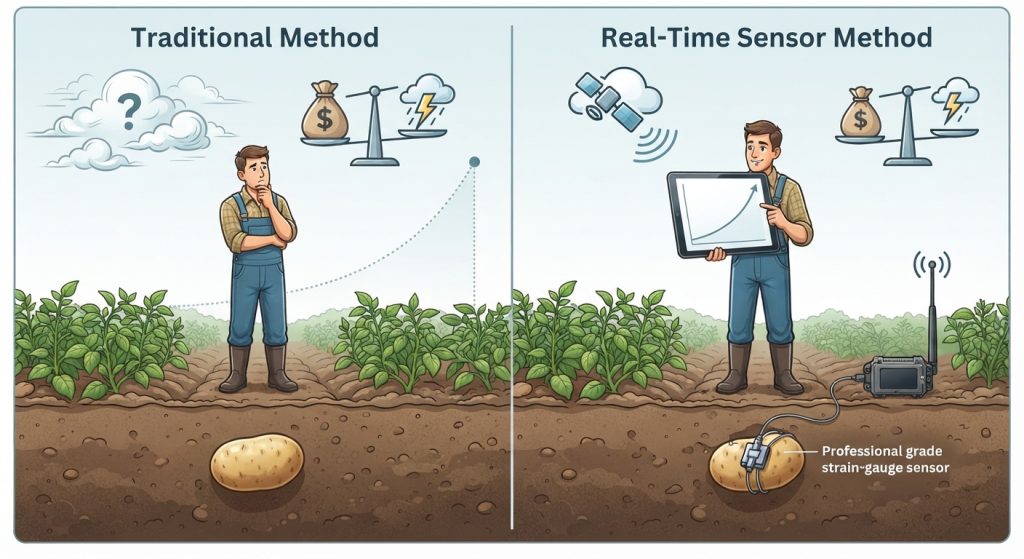
Right now, most harvest timing decisions weigh the cost of waiting (weather risk, storage windows, labor scheduling, disease pressure) against a rough sense of how much more yield is likely still coming. That second half of the equation has always been the harder one to pin down for underground crops, since there’s no way to just look and see how much bigger the tubers have gotten.
With a real-time growth number in hand, that comparison becomes much more concrete. A manager can weigh actual daily value added against actual daily costs, rather than estimating both sides of the equation. Even using a single well-placed sensor as a representative sample, paired with known field size and price, gives a grower a working daily figure to plan around instead of a guess.
Not Just About Squeezing Out Extra Days
It’s worth being clear that this works both directions. Sometimes the answer to “should I wait?” is no, because the value of additional growth is outweighed by risk, or because the tuber’s hydration level is heading toward a range that increases the odds of damage during storage and processing. Knowing the growth rate and water status in real time doesn’t just make a case for waiting longer. It also gives a grower better information to know when the smart move is to bring the harvest in on schedule, or even a little early.
The Bigger Idea Here
This is really a demonstration of something bigger: growth prediction for below-ground crops has historically lagged far behind what’s available for fruit and vegetable growers, who’ve had real-time sensors and models for years. Potato yield prediction, by contrast, has mostly relied on indirect, correlated data rather than direct measurement, because direct measurement underground has been so difficult.
A sensor like this doesn’t just answer “how big is this tuber right now.” It puts an actual number, in tons and dollars, behind the choice growers make every season about exactly when to stop waiting and start harvesting.
Based on: Link, S.O. “Real-Time Growth and Diurnal Thickness Variation of a Buried Solanum tuberosum (L.) Tuber.” Preprints.org, 2026. View the full paper here / Download the paper here