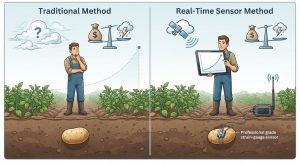
If you grow apples, tomatoes, or cherries, there’s a decent chance you’ve heard of sensors that clip onto the fruit and track its growth day by day. That kind of real-time monitoring has become fairly common for above-ground crops over the past couple of decades. But if you grow potatoes, sweet potatoes, or anything else that develops underground, that same kind of insight has mostly stayed out of reach. I wanted to lay out why that gap has existed for so long, and why it’s finally starting to close.
The Basic Problem: Soil Gets in the Way
The sensors used on fruit and stems work by gently clamping onto the plant tissue and detecting extremely small changes in thickness, changes measured in fractions of a millimeter. That works well in open air, where the sensor has a clean, stable connection to whatever it’s measuring.
Put that same kind of device underground, and things get complicated fast. Soil interferes with mechanical sensors both physically and electrically. Dirt shifts, settles, and presses unevenly against equipment in ways that open air simply doesn’t. A tool that works beautifully on a tree trunk can give unreliable, noisy readings once it’s buried.
What Researchers Have Tried Instead
Over the years, a few workarounds have been tested, each with real limitations.
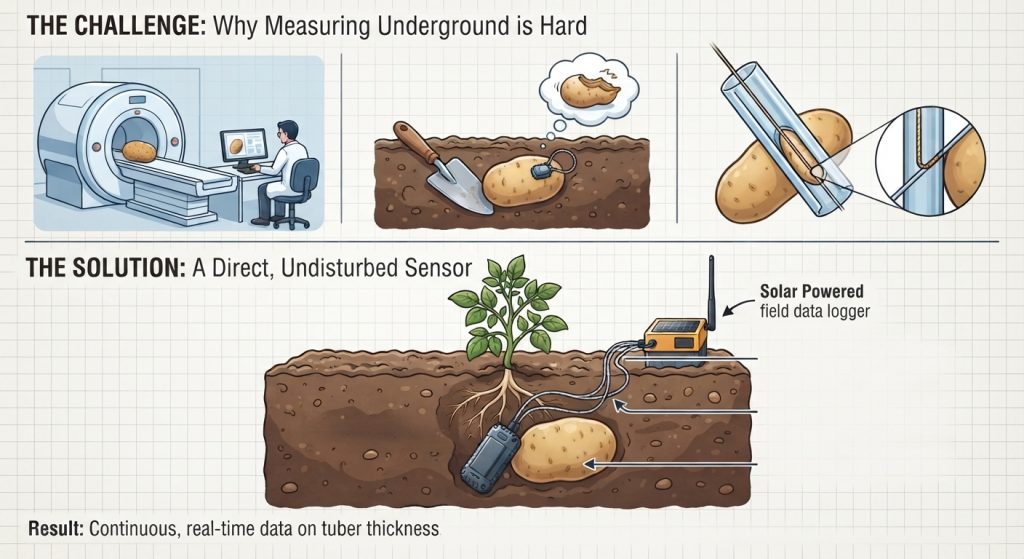
One approach uses magnetic resonance imaging, the same basic technology as a medical MRI machine, to look inside a growing tuber and track its water content and growth. This actually works quite well scientifically, but it only works in a lab. An MRI machine isn’t something you can haul out to a working field, and even in a lab setting, readings are typically limited to short windows, a measurement every few hours over just a few days.
Another approach has been to partially expose the tuber, removing soil so a standard sensor can reach it more directly. This avoids the interference problem, but it creates a different one: a tuber that’s had its surrounding soil disturbed and partly exposed isn’t necessarily behaving the way it would if left undisturbed. You end up measuring something, but not quite the same thing you set out to measure.
A more field-friendly attempt has used a wire-based sensor threaded through a tube to reach a nearly fully exposed potato. That’s closer to a real field setup, but the design has its own flaw: the wire tends to touch the side of the tube as the tuber shrinks and swells, which distorts the very signal it’s trying to capture. Researchers who tried this approach were candid that a better design was still needed.
Why This Gap Matters
This isn’t just a technical curiosity. It has real consequences for how below-ground crops get managed.
Above-ground growers can use continuous fruit and stem data to fine-tune irrigation, forecast yield early, and time harvest with real precision. Below-ground growers, by contrast, have mostly had to rely on indirect methods: correlating yield with other observable traits, using periodic soil sampling, or simply digging up test plants to check progress by hand. All of these approaches work to a degree, but none of them offer the same real-time, non-destructive window into what’s actually happening that above-ground growers have had for years.
Recent reviews of potato yield prediction methods have pointed to exactly this issue: efforts to predict yield without direct measurement have had mixed success, in part because indirect, correlated data is inherently less accurate than measuring the thing you actually care about. Machine learning approaches can help close some of that gap, but they need large datasets and are hard to put to use on an individual farm.
Closing the Gap
The approach I tested takes a sensor design that had already proven itself reliable on apples, tomatoes, cherries, cucumbers, and olives, and adapts it to work buried directly alongside a potato tuber, undisturbed, in a real, working field. Careful attention to a few details made this possible: shielding the sensor’s cable from light with a short length of pipe, correcting for the way temperature alone can shift the sensor’s readings, and filtering out electrical noise caused by things like passing irrigation equipment.
The result was a sensor that could sit quietly underground for two weeks, recording the tuber’s thickness every 15 minutes, without disturbing the plant or requiring a lab setting.
Why This Is a Meaningful Shift
None of the individual pieces of this solution are flashy. It’s mostly careful engineering: picking the right sensor design, protecting it from light and electrical noise, and correcting for temperature. But together, they solve a problem that’s been sitting in the way of real-time below-ground monitoring for a long time.
If this kind of sensor can be reliably adapted to potatoes, there’s a good chance it can be adapted to other below-ground crops too, sweet potatoes, and similar root and tuber crops that have historically been just as hard to monitor. That would mean growers of these crops finally getting access to the same kind of continuous, real-time picture that above-ground growers have relied on for years, instead of flying blind until harvest day.
Based on: Link, S.O. “Real-Time Growth and Diurnal Thickness Variation of a Buried Solanum tuberosum (L.) Tuber.” Preprints.org, 2026. View the full paper here / Download the paper here