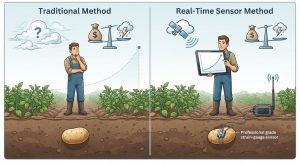
Good research tools sometimes fail in a very unglamorous way: not by giving wrong answers, but by simply not being practical enough to use for very long. That was the situation with plant dendrometers before this project. The idea behind them was solid, but the devices themselves had a design flaw that made them frustrating to work with on anything that grew quickly.
What a Dendrometer Needs to Do
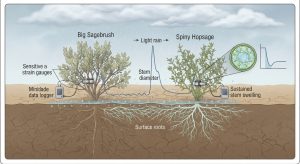
A dendrometer clips onto a stem or a piece of fruit and continuously tracks tiny changes in thickness, changes often measured in thousandths of a millimeter. To do that accurately, it needs a stable, sensitive mechanical connection to the plant tissue it’s measuring.
Earlier versions of these sensors were built with fairly rigid housings, made of solid materials like polyvinyl chloride or solid aluminum. That rigidity was good for precision, but it came with a real limitation: the sensor could only accommodate a fairly narrow range of thickness change before it had to be physically reset to keep working correctly.
Why That Was a Problem
For something that grows slowly, like a desert shrub adding a fraction of a millimeter to its stem over an entire season, a narrow range isn’t a huge issue. The sensor could comfortably track that kind of slow change for a long stretch of time without needing attention.
But for something growing quickly, like a piece of fruit that can put on several millimeters in just a couple of weeks, that narrow range became a real obstacle. The sensor would hit its limit and need to be manually reset, sometimes more than once during a single growing period. Each reset meant physically adjusting the device attached to living plant tissue, which risked deforming the stem or fruit, disturbing the very thing being measured, and introducing gaps or inconsistencies into the data right when continuous tracking mattered most.
In short, the tool that was supposed to quietly observe a plant’s growth was, in its own small way, interfering with it.
The Fix
The redesign we tested addressed this problem directly, and the solution was simpler than it might sound. Instead of a rigid housing, we built the sensor around a flexible stainless steel band, with the sensing elements, strain gauges arranged in a full Wheatstone bridge configuration, attached to the middle of that band.
That flexibility was the key change. It allowed the device to accommodate a much wider range of thickness change, up to 8 millimeters, without needing to be physically reset or risking damage to the stem or fruit clamped between its two aluminum bars.
Proving It Actually Worked
We tested this redesigned sensor, called the DEX70, in a real apple orchard in Mattawa, Washington, attaching it to tree trunks and to a piece of fruit and letting it record continuously for 15 days without a single reset. The fruit alone grew 3.3 millimeters over that period, comfortably within the sensor’s expanded range, something the older rigid designs would likely have struggled to track without intervention partway through.
We also carefully calibrated the relationship between the sensor’s electrical output and actual millimeter measurements, and confirmed that relationship held up cleanly across the sensor’s full range, from 0 to 12.7 millimeters, with a very strong, reliable correlation.
Why a Simple Fix Like This Matters
It’s tempting to think the most important advances in research tools come from complicated new technology. Sometimes, though, the most useful fix is a matter of rethinking one design choice, rigid versus flexible, that had been quietly limiting what a tool could do all along.
By solving the reset problem, this redesign made it realistic to track fast-growing tissue like fruit continuously, over an extended period, without interruption or disturbance. That’s a small mechanical change with a real practical payoff: better data, less disruption to the plant, and a tool that can finally keep up with how quickly fruit actually grows.
Based on: Link, S.O., Thiede, M.E., van Bavel, M.G. “An Improved Strain-Gauge Device for Continuous Field Measurement of Stem and Fruit Diameter.” Journal of Experimental Botany, Vol. 49, No. 326, pp. 1583-1587, 1998. View the full paper here / Download the paper here