If you grow fruit, you’ve probably heard of sensors that clip onto a stem or a piece of fruit and track its growth day by day. That technology has been around for years, and it works well because the fruit is right there, hanging in the open air where you can reach it.
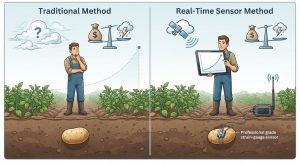
But what about crops that grow underground? A potato tuber is doing all the same things a piece of fruit does. It swells with growth, loses a little water during the heat of the day, and gains it back at night. Except it’s buried, out of sight, and out of reach of the tools growers normally use.
That’s the gap I set out to close in this study.
The Problem With “Out of Sight”
Soil is the issue. The same sensors that work well on an apple or a tomato tend to get thrown off underground, because dirt gets in the way, both mechanically and electrically. Some researchers have tried getting around this with MRI machines, but that only works in a lab, for a few hours at a time, and isn’t something you can run in a working field. Others have exposed part of the tuber to avoid the soil problem entirely, but that changes how the tuber behaves, since it’s no longer growing the way it normally would underground.
Nobody had a good way to watch a tuber grow, in real time, in an actual field, without disturbing it.
What I Tried
I took a sensor design that had already proven itself on apples, a small strain-gauge device that clips gently around the fruit and measures tiny changes in size, and adapted it for a buried potato tuber. The sensor was installed on a working potato field near Pasco, Washington, and left in place for 13 days leading up to harvest, quietly recording the tuber’s thickness every 15 minutes.
To keep light from reaching the tuber (which would make it green and unsellable), the sensor’s wiring ran through a short length of pipe pointed away from the sun. A soil moisture sensor nearby helped me understand what the sprinklers were doing to the readings, since passing irrigation equipment caused some electrical noise in the data. That noise had to be filtered out before the real signal could be seen clearly.
What I Found
Once the noise was cleaned up, a clear picture emerged.
-
The tuber grew steadily over the 13 days, about 0.90 millimeters thicker in total. That works out to roughly 1.33 grams of new growth per day, or a 4.8% increase in size before harvest.
-
The tuber also shrank and swelled a little every single day, losing a bit of water during the heat of the afternoon and recovering it overnight. At its biggest daily swing, that was about 9.4 milliliters of water, or 3% of everything the tuber held.
-
Hotter, drier days meant more water loss. The tuber’s daily water loss tracked closely with air temperature and how dry the air was (what we call vapor pressure deficit). The tuber acts like a small water reservoir for the plant, and it draws down harder when conditions are more demanding.
Why This Matters for Growers
This isn’t just an interesting lab result. It points toward some very practical possibilities.
-
Better harvest timing. If you can track exactly how much a tuber is still growing, day by day, you can make a more informed call about when one more day in the ground stops being worth the cost of waiting.
-
Smarter irrigation decisions. Since the tuber’s water loss rises and falls with heat and dryness, a sensor like this could help fine-tune watering, giving the plant what it needs instead of guessing.
-
Fewer storage and processing problems. Tubers that are too dry or too waterlogged at harvest are more prone to damage (bruising or dark spotting) during storage and processing. Knowing hydration levels in real time could help growers pick a harvest window that avoids both extremes.
Looking Ahead
What stands out to me about this study isn’t just the potato result. It’s proof that a sensor originally built for above-ground fruit can be adapted to work underground, in a real, working field, not just a lab. That opens the door to using similar tools on other buried crops, like sweet potatoes or other root vegetables, where growers have historically had almost no way to see what’s happening beneath the surface until harvest day.
For an industry that’s used to flying somewhat blind underground, this is a real step forward, and one I plan to keep building on.
Based on: Link, S.O. “Real-Time Growth and Diurnal Thickness Variation of a Buried Solanum tuberosum (L.) Tuber.” Preprints.org, 2026. View the full paper here / Download the paper here