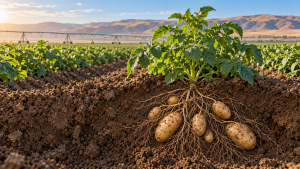
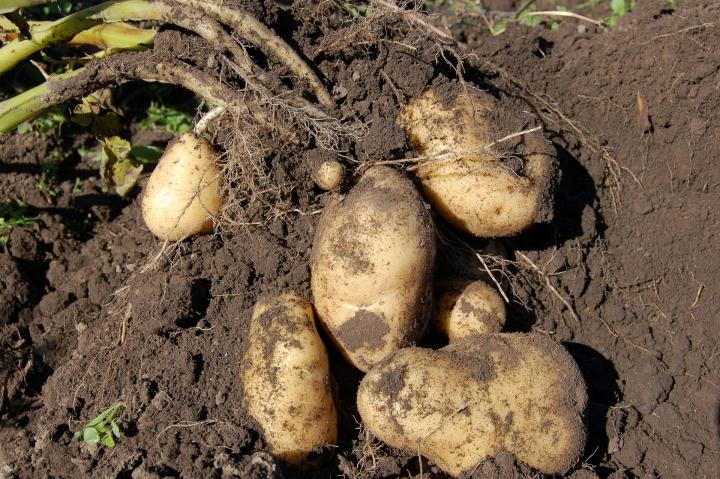
Most growers know their crops act differently in the heat of the day than they do overnight. Leaves wilt a little in the afternoon sun and perk back up by morning. But what about a potato, sitting entirely underground, out of sight the whole time? Does it have a day-night rhythm too?
That question was part of what I set out to answer with a buried tuber sensor I tested in a working potato field near Pasco, Washington, and the answer turned out to be yes, in a very measurable way.
A Tuber’s Daily Cycle
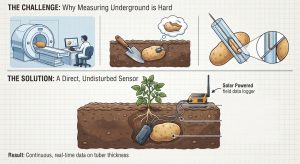
I clipped a small strain-gauge sensor around a potato tuber, buried it right alongside the plant in the field, and let it quietly record thickness every 15 minutes for 13 days leading up to harvest.
What showed up in the data wasn’t just the steady growth I expected. Layered on top of that growth was a smaller, repeating daily pattern: the tuber lost a bit of water and shrank slightly during the heat of the day, then recovered that water and swelled back overnight. Every single day, the same rhythm repeated.
At its largest, that daily swing amounted to about 9.4 milliliters of water, roughly 3% of everything the tuber held. Small in absolute terms, but a real and consistent signal.
Why This Happens
The explanation comes down to basic plant water movement. During the day, especially when it’s hot, the whole plant is losing water through its leaves faster than the roots can always keep up. When demand outpaces supply, the plant pulls water from wherever it can, including from the tuber itself, since a tuber isn’t just a storage organ for starch, it’s also a small reservoir of water the plant can draw on.
At night, that demand drops way down. Water loss through the leaves slows to almost nothing, so the roots catch up, water flows back into the tuber, and it swells back out again before the cycle repeats the next day.
The Part That Matters Most for Irrigation
Here’s the piece I think growers should pay closest attention to: the size of that daily water loss wasn’t random. It tracked closely with temperature and how dry the air was, what’s called vapor pressure deficit. On hotter, drier days, the tuber lost more water during the day. On milder days, the swing was smaller.
In other words, the tuber’s daily rhythm is really a live readout of how much water stress the whole plant is under on any given day. A bigger daytime dip means the plant is working harder to keep up with demand. A smaller one means conditions are easier, and the plant isn’t drawing as hard on its reserves.
Why This Is Useful, Not Just Interesting
If you’re timing irrigation by the calendar, or by a general sense of how hot it’s been, you’re working with a rough estimate. A tuber’s actual day-to-day water loss gives you something more direct: a real-time signal of how much stress the plant is experiencing on the hottest, driest days versus the milder ones.
That opens up a few practical possibilities. Watering could be timed more precisely around the days when the plant is really drawing down its reserves, rather than on a fixed schedule that doesn’t account for what the weather is actually doing. It could also help flag periods of stress building up before there’s any visible sign above ground, since by the time a potato plant looks stressed from the surface, the tuber underneath has often already been dealing with it for a while.
The Bigger Point
A potato’s daily rhythm underground isn’t just a curiosity. It’s a plant openly telling you, in a fairly precise way, how hard it’s working to keep up with the weather on any given day. The challenge has always been that nobody could easily listen in on that signal in a real field. This study is a step toward being able to do exactly that, continuously, and without digging anything up to check.
Based on: Link, S.O. “Real-Time Growth and Diurnal Thickness Variation of a Buried Solanum tuberosum (L.) Tuber.” Preprints.org, 2026. View the full paper here / Download the paper here