Picture two neighbors living through the same drought. Same soil, same sun, same lack of rain. One of them grits their teeth and keeps pushing, no matter how uncomfortable it gets. The other pulls back early, plays it cautious, and settles for less. Neither one is wrong. They’re just handling the same hard summer in very different ways.
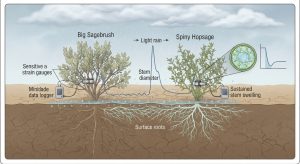
That’s essentially the story of two desert shrubs I studied side by side in southeastern Washington: big sagebrush and spiny hopsage. Same ground, same brutal dry summer, two completely different survival strategies.
Meet the Two Neighbors
Big sagebrush is the shrub most people picture when they think of the high desert. It’s evergreen, holding onto its leaves through the year, though it does grow a fresh flush each spring. Spiny hopsage takes the opposite approach. It’s drought deciduous, meaning it grows a full set of leaves in spring and then drops them entirely once things get too dry to sustain them.
We tracked both shrubs from March through July, right through the heart of the dry season, watching how each one handled the mounting stress.
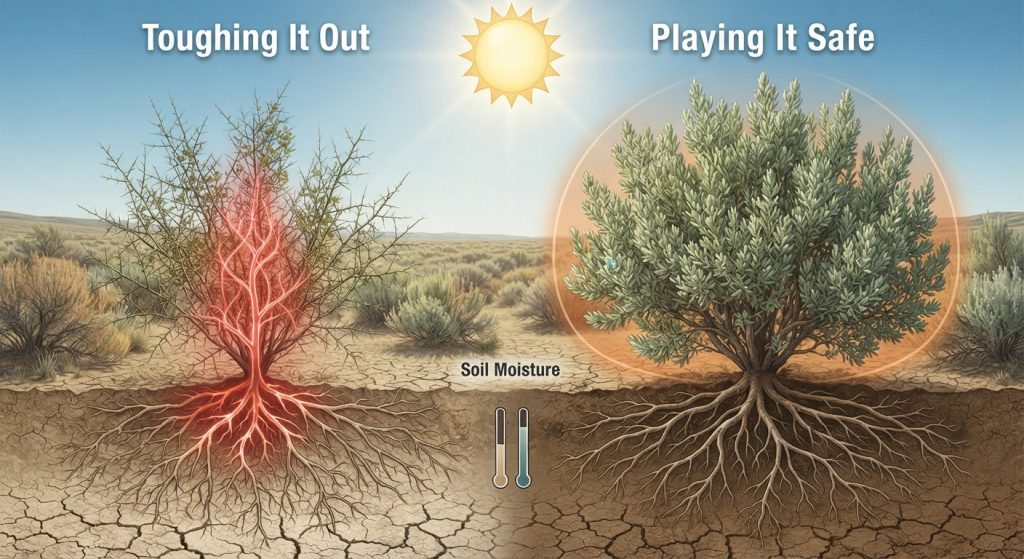
The Toughing-It-Out Strategy
Spiny hopsage is the one that grits its teeth. As the summer wore on, we measured its internal water tension, essentially a stress gauge for how hard the plant is having to work to pull water out of increasingly dry soil, and it climbed dramatically. By July, spiny hopsage had reached levels nearly double the stress of big sagebrush.
And it just kept going. It didn’t wilt, shut down, or give up. It tolerated levels of internal stress that would be genuinely rough for most plants, all so it could keep extracting whatever water remained in the soil. We found that spiny hopsage was pulling water from the ground more aggressively than big sagebrush, especially from the upper layers of soil, right up until early summer, at which point it had largely tapped out that resource and backed off.
The tradeoff for all that toughness was slower growth. Spiny hopsage put on noticeably less new leaf area and less stem growth over the season than its neighbor.
The Playing-It-Safe Strategy
Big sagebrush took the opposite bet. Its internal stress levels rose too, but far more gently, staying at a level roughly half of what spiny hopsage endured, even by the peak of summer stress. It never pushed itself into the same extreme territory.
That caution came with a payoff. Big sagebrush grew more over the season, both in leaf area and in stem diameter, than spiny hopsage did. By playing it safer with its water use, it kept enough of a margin to keep building, even while the summer dragged on.
Same Weather, Same Ground, Different Bets
What makes this comparison so interesting is that both of these strategies worked. Neither shrub died. Neither one “won.” They simply made different tradeoffs between risk and reward, and both tradeoffs paid off in their own way.
Spiny hopsage bet on toughness: tolerate more internal stress, keep pulling water even as the soil dries out, and accept slower growth as the cost of survival. Big sagebrush bet on caution: hold back before things get too extreme, protect a safety margin, and use that margin to keep growing a bit more, even if it means backing off the water table a little earlier than its neighbor might.
Interestingly, when we looked at how much water each plant was actually releasing through its leaves day to day, both shrubs looked almost identical, slowing down at nearly the same rate as summer progressed. The real difference wasn’t in their daily habits. It was in how far each one was willing to push its internal limits to keep functioning at all.
The Takeaway
There’s something worth sitting with here beyond the desert. Not every plant, and not every crop variety, handles the same drought or the same irrigation schedule the same way. Some are built to tolerate real stress and keep functioning. Others need a steadier hand and a bit more margin to perform well. Treating them all the same, assuming they’ll respond identically to identical conditions, misses exactly the kind of difference this study captured so clearly in two shrubs growing side by side in the same patch of desert.
Based on: Link, S.O., Thiede, M.E., Evans, R.D., Downs, J.L., Gee, G.W. “Responses of Big Sagebrush and Spiny Hopsage to Increasing Water Stress.” In: Proceedings: Wildland Shrub and Arid Land Restoration Symposium, 1993. Gen. Tech. Rep. INT-GTR-315. Ogden, UT: USDA Forest Service, Intermountain Research Station, 1994, pp. 196-201. View the full paper here / Download the paper here