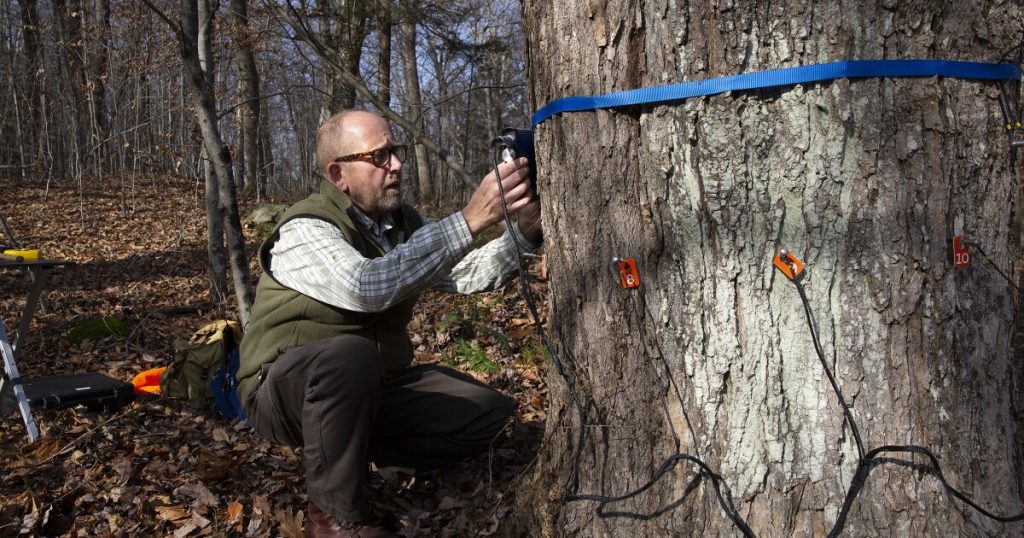
A tree doesn’t look like it’s doing much from the outside. It just stands there. But if you could zoom in close enough on its trunk, hour by hour, you’d see it quietly swelling and shrinking every single day, almost like it’s breathing. That daily rhythm is one of the clearest signals a tree gives about its water status, and for a long time, it was surprisingly hard to measure well.
This paper is about a sensor my colleagues and I built to solve that problem, and what we learned by putting it to work in a real apple orchard.
What a Dendrometer Actually Does
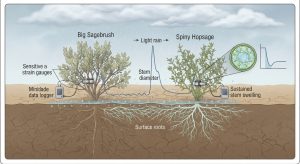
The instrument is called a dendrometer, and the idea behind it is simple: clamp a small, sensitive device onto a trunk or a piece of fruit, and let it continuously track tiny changes in thickness, changes far too small to see with the naked eye, sometimes just a few thousandths of a millimeter.
Why would thickness change at all? Because a stem is a bit like a flexible container of water. During the day, a tree loses water through its leaves faster than its roots can pull replacement water in from the soil, so the trunk tightens up slightly and gets thinner. At night, water use slows way down, the tree catches up on what it lost, and the trunk plumps back out. Over a full day, that adds up to a small but very real rhythm of shrinking and swelling.
Fruit does something similar, though usually with its own pattern layered on top, since it’s also actively growing at the same time.
The Problem With Earlier Sensors
Dendrometers had been around for a while before this study, but they had a real limitation. Older designs used stiffer materials, which meant they could only handle a fairly narrow range of thickness change before they had to be manually reset to keep working properly. For a slow-growing desert shrub, that’s not a huge issue. But for something like a piece of fruit, which can grow several millimeters over just a couple of weeks, constantly resetting the sensor gets impractical fast, and every reset is a chance to disturb the reading or the plant tissue itself.
We wanted a version that could handle a much wider range of movement without needing constant attention.
What We Built
The redesign centered on one key change: instead of a stiff housing, we used a flexible stainless steel band, with the sensing elements attached in the middle of that band. This let the device flex along with a much bigger range of thickness change, up to 8 millimeters, without needing to be physically reset or risking damage to the stem or fruit it was clamped onto.
We tested two sizes of this sensor (one built for tree trunks, one small enough for fruit) in an apple orchard in Mattawa, Washington, over 15 days in September, with two units on tree trunks and one on a piece of fruit.
What We Found
The trunk sensors picked up exactly the rhythm we expected: thinner during the day, thicker at night, repeating day after day, with about 0.7 millimeters of total daily change. Both trunks, on separate trees, showed a strikingly similar pattern, which told us they were both experiencing very similar water conditions, reasonable in an irrigated orchard where every tree gets watered on the same schedule.
The fruit told a different story. Instead of a strong daily shrink-and-swell cycle, the apple mostly just grew, steadily adding size day after day, for a total increase of 3.3 millimeters over the two weeks, with only a mild daily wobble layered on top. That fits with something we already suspected: fruit fills up mostly through a different internal water pathway than the trunk does, so it behaves more like a steadily inflating balloon than a container losing and regaining water each day.
We also paid close attention to something easy to overlook: temperature itself can subtly affect the sensor’s readings, separate from any real change in the plant. We measured that effect directly and found it was small but real enough to correct for, which mattered for making sure what we were seeing in the data was actual plant behavior, not just the equipment reacting to a warm afternoon.
Why It Matters
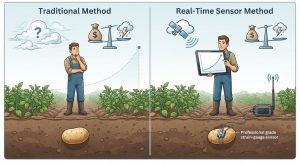
None of this is just an academic curiosity. Being able to track a trunk’s or fruit’s thickness continuously, accurately, and without constant manual resets, means growers and researchers can get a real-time window into how a tree or a piece of fruit is handling water, day after day, through an entire season. That kind of continuous data can flag water stress early, long before it shows up as wilting or a drop in fruit quality, and it can do it automatically, out in a working orchard, not just in a controlled lab setting.
That’s really what this whole project was about: building a tool simple and durable enough to just sit on a tree and quietly tell the truth about what’s happening underneath the bark.
Based on: Link, S.O., Thiede, M.E., van Bavel, M.G. “An Improved Strain-Gauge Device for Continuous Field Measurement of Stem and Fruit Diameter.” Journal of Experimental Botany, Vol. 49, No. 326, pp. 1583-1587, 1998.
Based on: Link, S.O., Thiede, M.E., van Bavel, M.G. “An Improved Strain-Gauge Device for Continuous Field Measurement of Stem and Fruit Diameter.” Journal of Experimental Botany, Vol. 49, No. 326, pp. 1583-1587, 1998. View the full paper here / Download the paper here