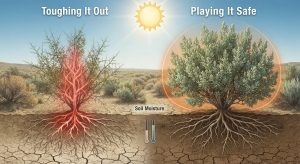
A light rain, the kind that barely dampens the top layer of soil, doesn’t seem like it should matter much to a plant with roots reaching a foot or more into the ground. It’s easy to assume a shower like that just evaporates off before it does anything useful. But when we tracked stem measurements on two desert shrubs through a dry summer, the data told a different story: plants notice rain almost immediately, even when there isn’t much of it.
What We Were Watching For
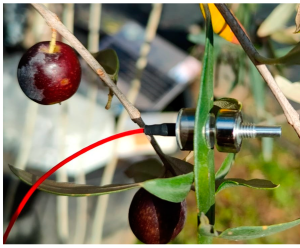
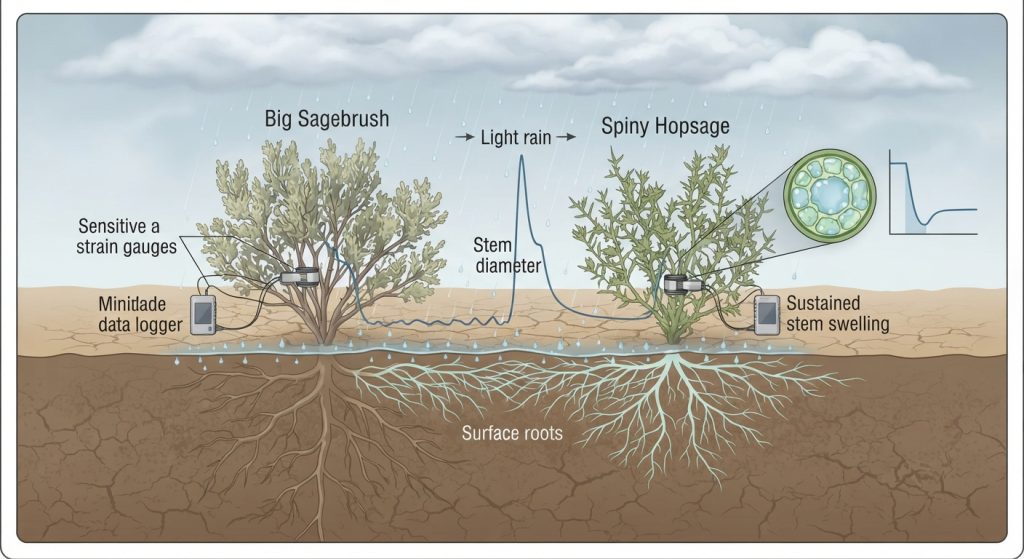
We had sensitive strain gauges clamped onto the stems of big sagebrush and spiny hopsage, recording data hourly from March through July in a dry region of southeastern Washington. Alongside that, we tracked daily precipitation at the site.
Rain fell in three separate windows during the study. Most of these events were small. The single biggest one was only 8.5 millimeters, and most days brought less than 4 millimeters, some as little as 2. That’s a light rain by almost any measure, barely enough to leave puddles.
The Response Was Fast and Clear
Every time rain fell, stem diameter spiked upward, and it happened quickly, within the same day. This wasn’t a subtle trend buried in the data. It showed up as a clear, repeatable pattern: rain event, stem swells.
That tells us something important about how these shrubs are built. To respond that fast to a shallow, light rain, a plant needs active roots sitting near the surface, ready to take up whatever water is available before it evaporates or drains past reach. Deep roots alone couldn’t explain a response this quick, since water from a light rain simply doesn’t travel far down into the soil profile.
Not Just an Immediate Blip
What made this even more interesting was that the swelling wasn’t just a brief flicker. Stem diameter increases from these small rain events tended to hold, contributing to the shrubs’ overall growth for the season, not just a fleeting spike that faded within hours.
There’s also a second factor likely playing a role. Rainy periods tend to bring cloudier, cooler weather along with them, which slows down how much water a plant loses through its leaves. So during and right after a rain, a plant may be taking in water faster than it’s losing it through transpiration, a double benefit that helps explain why the stem swelling shows up so clearly and holds up over time.
Why This Matters for Irrigation Timing
If a plant’s stem visibly responds to a rain event within hours, that’s a pretty strong argument for how sensitive and immediate plant water uptake really is, and it has direct implications for irrigation.
For one, it suggests that even light, frequent watering can matter more than it might seem, especially for plants with active surface roots ready to take advantage of it. It also means that the value of an irrigation event doesn’t need days to show up. If a stem sensor can detect a real response within hours of a small rainfall, the same kind of monitoring could just as easily confirm whether a given irrigation event actually reached the plant and made a difference, rather than waiting to find out days later through crop appearance alone.
The Bigger Picture
It’s tempting to think of a light rain as barely worth mentioning next to a plant’s overall water needs for an entire season. But this data suggests these shrubs are built to take full advantage of exactly that kind of small, unpredictable moisture, responding almost as fast as the rain itself falls. That kind of sensitivity is easy to miss with the naked eye, but it shows up clearly and immediately in stem measurements, and it’s a reminder of just how responsive a plant’s internal water system really is to even modest changes in conditions.
Based on: Link, S.O., Thiede, M.E., Evans, R.D., Downs, J.L., Gee, G.W. “Responses of Big Sagebrush and Spiny Hopsage to Increasing Water Stress.” In: Proceedings: Wildland Shrub and Arid Land Restoration Symposium, 1993. Gen. Tech. Rep. INT-GTR-315. Ogden, UT: USDA Forest Service, Intermountain Research Station, 1994, pp. 196-201. View the full paper here / Download the paper here