Out on the Hanford Site in southeastern Washington, summers are long, hot, and dry. Most years bring only about 160 mm of rain, and almost all of it falls in the fall and winter. By the time summer rolls around, the land is dominated by two tough, unrelated shrubs that have figured out very different ways to get through it: big sagebrush and spiny hopsage.
I wanted to understand exactly how these two neighbors, growing side by side in the same dirt, facing the same heat and the same lack of rain, end up handling water stress so differently. So my colleagues and I tracked their leaf growth, their stem width, their internal water status, and their photosynthesis from March through July, as the dry season tightened its grip.
Two Very Different Game Plans
Big sagebrush is an evergreen. It holds onto some of its foliage all year, though it does grow a flush of new leaves in spring and drops some of them again as summer stress builds. Spiny hopsage plays it differently. It’s drought deciduous, meaning it grows a full set of new leaves each spring and then drops all of them once water gets scarce enough.
Those two strategies showed up clearly in our data. From March to June, big sagebrush increased its leaf area by 319%, while spiny hopsage increased by 197%. Big sagebrush simply put on more green growth over the season.
The Stem Tells the Real Story
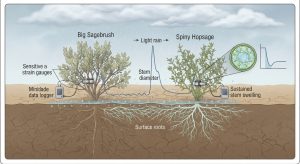
Here’s where it gets interesting. We attached sensitive strain gauges (thin sensors that can detect changes as small as a tenth of a micron) directly to the stems of both shrubs, and left them recording continuously for months.
What we found is that a stem isn’t just structural. It’s a water tank. Both shrubs showed the same basic pattern: stems swelled a bit after rain and shrank as the days got hotter and drier. Even small rain events, some as little as 2 millimeters in a day, showed up as a visible bump in stem width within hours. That tells us these shrubs have roots working right near the surface, ready to grab whatever moisture shows up, even a light sprinkle.
By the end of the season, big sagebrush had added an average of 0.23 millimeters to its stem diameter, almost double the 0.11 millimeters added by spiny hopsage. Once again, big sagebrush came out ahead in growth.
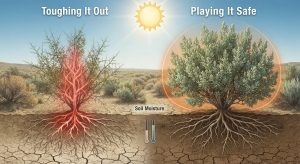
Toughing It Out vs. Playing It Safe
So if big sagebrush grows more, does that mean it’s the tougher plant? Not exactly. It’s the opposite, in a way.
We measured each shrub’s xylem pressure potential, which is a way of tracking how much internal water tension a plant is under. Think of it as a stress gauge. In March, both shrubs sat around a similar, fairly relaxed value of about -2.0 MPa. By July, big sagebrush had only dropped to -3.3 MPa, while spiny hopsage had pushed down to -6.2 MPa, nearly double the stress level.
And yet, spiny hopsage kept functioning at that much harsher internal water status. It didn’t wilt or shut down. It just tolerated far more internal stress than big sagebrush ever did.
Interestingly, when it came to photosynthesis and how much water vapor the leaves released through their pores, the two shrubs looked almost identical, both slowing down steadily as the summer wore on. The real difference wasn’t in how they used water day to day. It was in how much internal stress each one was willing and able to withstand to keep pulling water from a drying soil.
What This Suggests
Put together, the picture looks like this: spiny hopsage survives the dry season by reaching deeper into its own tolerance for stress, extracting water from the soil even as conditions get harsh, while accepting slower growth as the tradeoff. Big sagebrush takes a steadier, more moderate approach, keeping its internal water stress lower and using that safety margin to keep growing a bit more throughout the season.
Neither strategy is “better.” They’re just different bets on how to survive the same dry summer. One shrub pushes closer to its limits and holds back on growth. The other stays cautious and banks a bit more growth instead.
Why This Matters Beyond the Desert
You don’t need to be managing sagebrush and hopsage to find something useful here. Any grower dealing with multiple varieties, or with plants that respond differently to the same irrigation schedule, is watching a version of this same story play out. Not every plant handles water stress the same way, even under identical weather. Some varieties tolerate more stress and keep functioning. Others need a steadier hand to keep growing well.
And the stem data is a reminder of something I think gets overlooked: a stem swelling or shrinking isn’t just background noise. It’s one of the clearest, fastest signals a plant gives about its water status, often responding within hours of a change in conditions. That’s exactly the kind of signal that real-time monitoring can pick up on, well before stress becomes visible in the leaves.
Based on: Link, S.O., Thiede, M.E., Evans, R.D., Downs, J.L., Gee, G.W. “Responses of Big Sagebrush and Spiny Hopsage to Increasing Water Stress.” In: Proceedings: Wildland Shrub and Arid Land Restoration Symposium, 1993. Gen. Tech. Rep. INT-GTR-315. Ogden, UT: USDA Forest Service, Intermountain Research Station, 1994, pp. 196-201. View the full paper here / Download the paper here