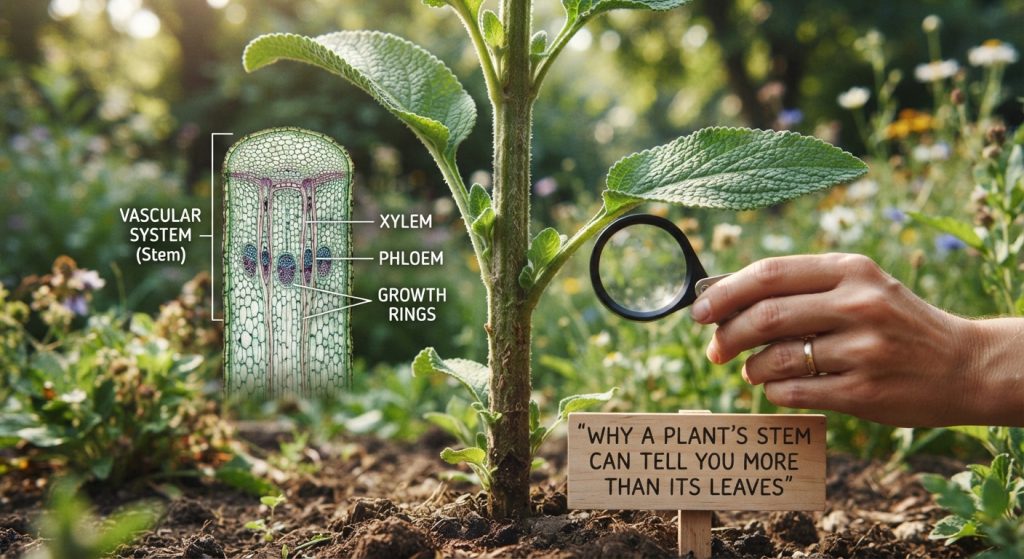
When most people think about checking on a plant’s health, they look at the leaves. Are they wilting? Curling? Turning brown at the edges? It’s a natural place to look, since leaves are the most visible part of the plant. But leaves are often one of the last places water stress shows up, not the first. Long before a leaf visibly wilts, the stem has usually already been telling a much more immediate story, if you know how to read it.
That’s something I saw clearly in a study comparing two desert shrubs, big sagebrush and spiny hopsage, as they moved through a dry summer in southeastern Washington.
A Stem Is a Water Tank
We attached sensitive strain gauges directly to the stems of both shrubs, sensors capable of detecting changes as small as a tenth of a micron, and recorded continuously for months, from March through July.
What we found is that a stem behaves a lot like a small, flexible water reservoir. It isn’t just rigid structural support. When rain falls, roots pull in water, and some of that water gets stored in the stem itself, causing it to physically swell. When conditions dry out and the plant is losing more water through its leaves than its roots can replace, the stem shrinks as that stored water gets drawn down and used.
Both shrubs, despite being very different species with very different survival strategies, showed this same basic pattern.
Rain Shows Up Almost Immediately
One of the clearest signals in the data came right after rainfall. Precipitation occurred in three separate windows during the study, and every single time, stem diameter spiked upward within hours of the rain.
What’s notable is how small some of these rain events were. Most daily totals were under 4 millimeters, some as little as 2 millimeters, yet the stems still responded quickly and visibly. That tells us these shrubs keep roots active near the surface, ready to take up even a light, brief rain before it has a chance to evaporate or drain away. A stem sensor picked up that response almost as fast as the rain itself fell, well before you’d see any visible change in the leaves.
The Slow Drift Tells a Longer Story Too
Beyond the quick spikes after rain, there was also a slower, longer-term pattern. Both shrubs’ stems grew in diameter through the spring, reached a peak, and then began shrinking as the summer dry season deepened. Big sagebrush peaked later, around day 137 of the year, while spiny hopsage peaked earlier, around day 129, and pulled back sooner.
That gradual shrinkage as summer wore on wasn’t just about slowing growth. It reflected real, ongoing dehydration, water being drawn out of the stem faster than it could be replaced, as the soil dried out and the season’s stress accumulated. In other words, the stem wasn’t just responding to individual rain events. It was quietly keeping a running record of the whole season’s water balance.
Why Leaves Alone Miss This
Leaves do respond to water stress too, eventually. But by the time you can see wilting, curling, or leaf drop, the plant has often already been under real stress for some time. A stem, by contrast, is registering changes in water status almost continuously and often much sooner, because it’s directly plumbed into the plant’s water transport system in a way that’s easy to measure precisely and hard to see just by looking.
This is part of why stem measurement has become such a valuable tool in plant water research generally. It’s not that leaves don’t matter. It’s that a stem gives you an earlier, steadier, and more precise signal, one that shows up in hours rather than days, and one that can be tracked with a sensor continuously instead of relying on a visual check that only catches problems after they’ve already taken hold.
The Practical Takeaway
For anyone managing crops rather than desert shrubs, the lesson translates directly. Waiting for visible signs of stress in the leaves means you’re already behind. A plant’s stem is telling that story much earlier, responding to rain, heat, and drying conditions in near real time. The challenge has simply been having a practical way to listen in on that signal continuously, in a real field, rather than relying on the eye alone.
Based on: Link, S.O., Thiede, M.E., Evans, R.D., Downs, J.L., Gee, G.W. “Responses of Big Sagebrush and Spiny Hopsage to Increasing Water Stress.” In: Proceedings: Wildland Shrub and Arid Land Restoration Symposium, 1993. Gen. Tech. Rep. INT-GTR-315. Ogden, UT: USDA Forest Service, Intermountain Research Station, 1994, pp. 196-201. View the full paper here / Download the paper here